Non-standard metal stamping forming is among the most versatile and economically efficient manufacturing approaches available today. Unlike catalog-driven standard stamping, non-standard forming is driven entirely by customer geometry — accommodating profiles, load requirements, and finish specifications that off-the-shelf solutions simply cannot match. At ACRO Metal Products Ltd., non-standard stamping underpins everything from automotive structural brackets to precision office furniture components — all engineered in-house from tooling design through final assembly.
Reference Product: ACRO's Metal Stamping Forming Support Leg for Office Table — a 678 mm × 77 mm custom steel leg manufactured via stamping, TIG welding, plug welding, polishing, and E-coating — illustrates exactly how multi-step non-standard forming creates production-grade structural parts.
Standard stamping produces commodity shapes — washers, simple flanges, blanks — in high volumes from pre-existing die sets. Non-standard stamping begins with a customer drawing or sample; the manufacturer then designs bespoke tooling, validates the manufacturing feasibility, and produces a part geometry unique to that application.
ACRO's full product range encompasses non-standard stamping parts, welding parts, and assembly parts, each produced by dedicated tooling built and maintained in the company's own workshop — eliminating third-party tooling delays and providing direct control over dimensional quality.
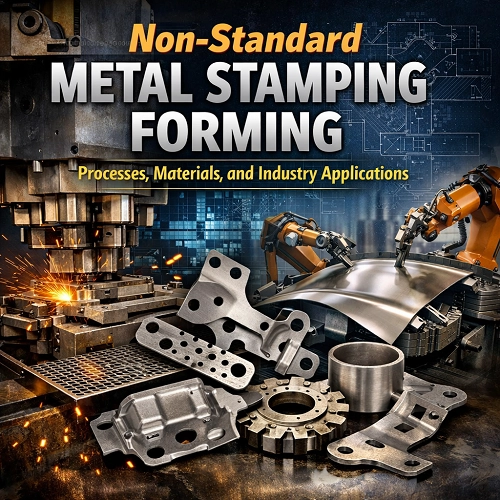
Non-standard stamping is not a single operation but a family of related cold-forming techniques selected and sequenced according to part geometry and material.
Shearing a flat 2-D profile from coil stock with tight edge quality. Fine blanking reduces the rollover zone to <5% of material thickness.
Multiple forming stations in a single die set — blanking, piercing, bending, embossing — accomplished in one press stroke. Ideal for complex, high-volume parts.
A punch forces a flat blank into a die cavity, producing cup or box profiles with no material removal. Requires careful blank-holder pressure control to avoid wrinkling or tearing.
CNC press-brake bending and AMADA CNC bending equipment create precise angles and channels. Roll forming suits long, constant cross-section profiles.
Surface texturing and dimensional correction under high tonnage. Coining achieves ±0.01 mm tolerances by fully plastically deforming the material between die faces.
Fluid pressure replaces a rigid punch, enabling very complex closed cross-sections in a single step — common in automotive structural parts.
Selecting the right forming process depends on part complexity, tolerance requirement, production volume, and material. The table below summarises the primary decision factors:
| Process | Typical Tolerance | Best Material | Volume Suitability | Tooling Cost | Part Complexity |
|---|---|---|---|---|---|
| Single-Station Stamping | ±0.1 – 0.3 mm | Low-carbon steel, aluminium | Medium | Low | Simple profiles |
| Progressive Die Stamping | ±0.05 – 0.15 mm | Steel, stainless, brass | High | Medium–High | Multi-feature, thin-wall |
| Deep Drawing | ±0.05 – 0.2 mm | Low-carbon steel, aluminium, copper | High | Medium | Cups, enclosures, cylinders |
| Fine Blanking | ±0.01 – 0.05 mm | Steel, stainless | High | High | Gear-like profiles, tight edges |
| Hydroforming | ±0.1 – 0.25 mm | Aluminium, HSLA steel, titanium | Low–Medium | High | Hollow closed sections |
| CNC Bending (Press-Brake) | ±0.1 – 0.5 mm | Any sheet metal | Low–Medium | Low | Angular, simple bends |
Material selection governs not only mechanical performance but also springback behaviour, die wear, and post-process compatibility. ACRO's equipment fleet — from 16-ton to 500-ton stamping machines — accommodates a wide material portfolio:
A stamped blank is rarely a finished part. Non-standard production chains typically combine several secondary operations. ACRO's office table support leg exemplifies a five-step chain:
Tungsten Inert Gas (TIG) welding delivers clean, precise fusion joints with minimal spatter — essential when weld-bead appearance and joint fatigue life both matter. For the office table leg, TIG joins the main stamped channel sections, while plug welding bonds overlapping flanges where access for a continuous bead is limited. ACRO's Panasonic automatic welding robots provide repeatable arc parameters across production batches.
Post-weld grinding removes spatter and flattens proud weld caps. Polishing — performed in stages from coarse abrasive to fine buffing — brings the surface to the roughness (Ra) specified for downstream coating adhesion. A poorly prepared surface is the most common root cause of coating delamination in service.
E-coating immerses the part in a water-borne paint bath and applies a DC voltage that drives paint particles onto the metal surface electrophoretically. Advantages over conventional spray painting include:
ACRO received a 2D drawing for a steel table support leg measuring 678 mm × 77 mm for a corporate furniture programme. Key engineering milestones included:
Full product details: Support Leg For Office Table
Die quality determines part quality. ACRO's dedicated tooling manufacturing centre designs and machines every die in-house using HAAS CNC machining centres and CNC lathes. Benefits of this vertical integration:
Non-standard parts often feed safety-critical assemblies in automotive, medical, or industrial end-uses, making documented quality systems non-negotiable. ACRO's quality inspection framework operates under two internationally recognised standards:
General quality management system covering process control, customer focus, continual improvement, and corrective action.
Automotive-sector quality standard mandating APQP, PPAP, FMEA, SPC, and MSA — ensuring production parts match validated prototypes.
The ability to customise geometry, material, and surface finish means non-standard stamping serves almost every manufacturing sector. ACRO's application portfolio spans:
Choosing a non-standard stamping partner involves far more than press capacity. ACRO's core competitive advantages include an experienced engineering team, owned tooling infrastructure, a proprietary technical patent portfolio, and a proven track record of resolving complex cross-industry manufacturing challenges.
Latest company activities — including ACRO's 2025 appearance at the Morocco (Jiaxing) Trade Week — are covered on the Company News and Industry News pages.
Share your drawing or sample with ACRO's engineering team for a free feasibility review and quotation.
Contact ACRO Today Browse All Products