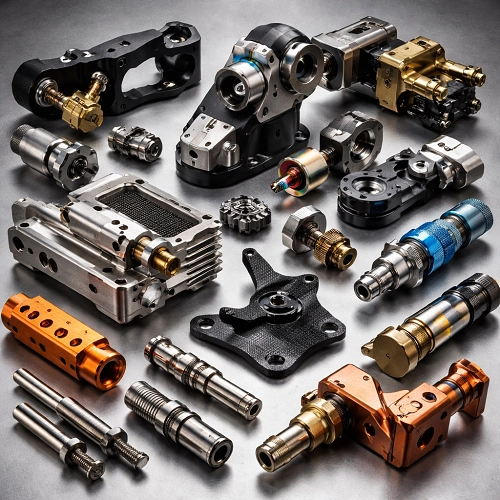
In modern manufacturing, efficiency and consistency are often associated with standardization. However, Non‑Standard Assembly Parts—components designed for specific applications rather than mass-produced norms—play a critical role in enabling innovation, performance optimization, and competitive differentiation.
Non-standard parts allow designers to break free from the constraints of catalog components. When standard fasteners, fittings, or housings cannot meet functional or aesthetic requirements, custom parts enable:
This flexibility is especially important in industries like aerospace, medical devices, automotive engineering, and consumer electronics, where innovation often depends on precise customization.
Standard parts are designed to work “well enough” across many applications.
By tailoring materials, dimensions, and manufacturing processes, engineers can significantly improve durability, reliability, and overall system performance.
This is particularly valuable in compact or complex systems where space constraints or weight reduction are critical. Integrated non-standard components often reduce the need for adapters or secondary fasteners.
Products that rely solely on standard components are easier to replicate.
In competitive markets, this differentiation can be a key factor in brand recognition and customer loyalty.
Modern manufacturing methods—such as CNC machining, additive manufacturing (3D printing), and advanced forming techniques—have made non-standard parts more feasible and cost-effective.
These technologies have reduced the traditional cost and time barriers associated with custom components.
In some cases, a single custom component can replace multiple standard parts, simplifying supply chains and reducing environmental impact.
While standard parts remain essential for cost control and scalability, non-standard assembly parts are indispensable in modern manufacturing and design. They enable innovation, optimize performance, and support advanced manufacturing strategies. As production technologies continue to evolve, the strategic use of non-standard components will only become more central to high-value, high-performance product development.